
Not the Righteous, But the Needy: A Good Friday Reckoning
Based on a talk by Rev. Fr. Pachomius Ma. San Juan, OSB
Today is Good Friday, the day we stand before the Cross.
After forty days of Lent, of prayer, fasting, and sacrifice, we arrive here. And it’s tempting to ask: Have I done enough? Have I become better? Holier? Worthier?
But as we look at Christ crucified, those questions begin to fall away.
A Gospel passage from early in Lent tells of the call of Levi, the tax collector, despised, rejected, unworthy in the eyes of many. And yet, it is to him that Jesus says, “Follow me.” And in the presence of the self-righteous, He declares: “I have come not to call the righteous, but sinners to repentance.”
On Good Friday, those words take on a deeper meaning.
The truth the Cross reveals
Lent is not about ashes, though it begins with them. It is not about fasting, though we are called to it. It is not even about penance, though we practice it.

Standing before the Cross, we see what Lent has been trying to reveal all along: The truth. And the truth is this: we are not well. We are fractured, wounded, inconsistent, and in need of healing. And it is precisely for this reason that Christ hangs on the Cross, not for the worthy, but for the needy. Not for the perfect, but for the broken.
We sometimes treat Lent like a spiritual performance review, a season to prove ourselves. But the Cross makes it clear: we cannot save ourselves. Grace does not come as a reward for effort. It comes as a gift poured out.
Before receiving Communion, we say: “Lord, I am not worthy… but only say the word and I shall be healed.” Today, we see the cost of that healing.
The danger of thinking we are well
In the Gospel, Levi responds with joy and throws a banquet. Sinners gather at the table with Jesus, while the Pharisees remain distant, unable to enter because of their judgment.
On Good Friday, we see where that distance leads. The ones who believed themselves righteous could not recognize mercy when it stood before them. Their certainty became a wall.

And perhaps that same temptation lives quietly in us. The most dangerous illness is not sin, it is the illusion that we are already well. That we have no need of mercy. It shows up in comparison, in quiet judgment, in the subtle thought: “At least I’m not like that.” But at the foot of the Cross, comparison collapses. There is no “better” or “worse” there. Only need.
Repentance is a return
Good Friday is not a day of shame. It is a day of return. Repentance, metanoia, is not about self-condemnation. It is about turning back. Reorienting the heart. Coming home.
Jesus does not condemn sinners. He carries them. Even on the Cross, His words are not of rejection, but of mercy: “Father, forgive them.” He does not drive us away. He opens His arms, literally, to receive us.
The divine physician who draws near
Jesus called Himself a physician, one who comes for the sick. And today, we see just how far that Physician is willing to go.
He does not remain distant from our suffering. He enters it. He does not wait for us to be healed. He becomes wounded for us.
So often, we hesitate to come to God until we feel “ready.” But the Cross reveals a God who meets us in our unreadiness, our brokenness, our mess.

Confession, prayer, fasting, generosity, these are not punishments. They are medicine. And the Cross is the ultimate remedy, love poured out without measure.
The table of mercy and the wood of the Cross
So many moments in the Gospel happen around a table. Jesus eating with sinners, gathering people close. But today, the table becomes the Cross. The place of communion becomes the place of sacrifice.
Every Mass draws us into this mystery, a gathering not of the righteous, but of sinners in need of mercy. We do not come because we are worthy. We come because we are hungry.
Lent has been preparing us for this, not to make us perfect, but to make us open. Open enough to receive. Humble enough to kneel. Honest enough to stay.
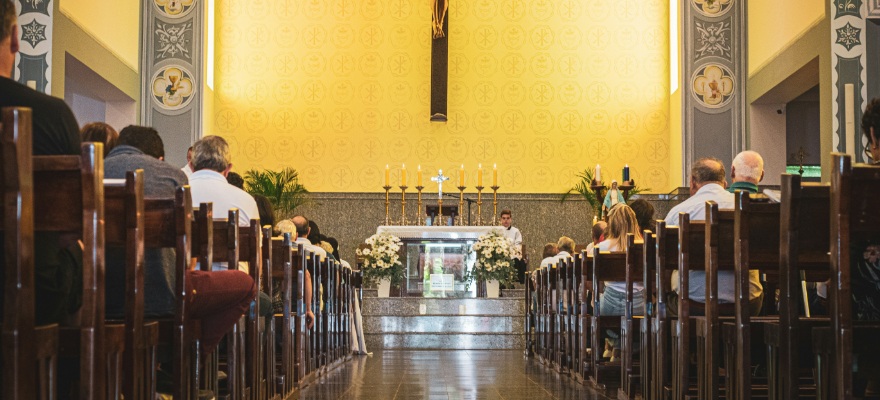
Because Christ does not wait for a spotless heart before entering. Even now, He enters our brokenness, and begins the work of healing from within.
The courage to stay at the Cross
Today, the question is no longer whether we have done Lent well. The question is this:
Will we stay? Will we remain at the foot of the Cross, not as spectators, but as those in need? Will we allow ourselves to be seen in our weakness, and loved there?
Because here is the great consolation of Good Friday: If you feel your sin, your weakness, your need, then you are exactly the person Christ is dying for. Lent was never about proving ourselves to God. It was about bringing us here, to the place where we finally allow God to save us.
And perhaps today, this is enough:
Lord, I am not righteous—but I am Yours.
Stay with me. Heal me. Lead me home.